
Square is Now Available Through Costa Systems: Hardware, Pricing & Local Irish Support
Sales Are Up. But Are Irish Retailers Actually Selling More?
At first glance, the latest Irish retail figures look positive.
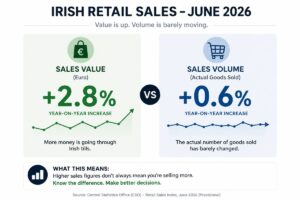
According to the Central Statistics Office, the value of retail sales increased by 2.8% year-on-year in June 2026.
But look a little closer and the picture changes.
Over the same period, the actual volume of goods sold increased by just 0.6%.
In other words, more money is going through Irish tills — but retailers aren’t necessarily selling significantly more products.
And for business owners, that distinction matters.
Revenue Doesn’t Tell the Whole Story
It’s easy to look at your end-of-day, weekly or monthly sales figure and assume that a higher number means the business is performing better.
But what is actually driving that increase?
Are you serving more customers?
Are customers buying more items?
Are particular products performing better?
Or are higher prices simply making the revenue figure bigger?
This is particularly relevant for fashion retailers.
The latest CSO Consumer Price Index shows that clothing and footwear prices were 8.5% higher in July 2026 than a year earlier.
That means a retailer could see revenue increase while the number of products actually leaving the shop remains relatively flat.
A €50,000 month becoming a €53,000 month looks like growth.
But if your prices, stock costs and operating expenses have also increased, that extra €3,000 doesn’t necessarily mean the business is performing better.
The Numbers Behind the Number
This is why modern retail management needs to go beyond simply asking:
“How much did we take today?”
The more useful questions are:
What did we sell?
How many did we sell?
What margin did we make?
Which products are moving fastest?
Which products are sitting on the shelf?
Which departments are actually growing?
What is happening online compared with in-store?
A headline sales figure can’t answer those questions.
Your retail data can.
Know What’s Actually Driving Your Sales
Imagine two fashion retailers both report a 10% increase in revenue.
On paper, their performance looks identical.
But Retailer A has increased transaction numbers, maintained healthy margins and sold more products across several departments.
Retailer B has processed roughly the same number of transactions as last year, sold fewer individual products and generated the additional revenue primarily through higher prices.
Those are two very different businesses.
Without detailed reporting, however, the headline numbers can look remarkably similar.
That’s where having the right EPOS system becomes increasingly important.
Stock Control Is Part of the Story
Sales reporting also needs to connect directly with stock.
Knowing that a product generated €5,000 in sales is useful.
Knowing that it generated €5,000 while maintaining a strong margin, sold through quickly and now needs replenishment is much more useful.
Likewise, slow-moving stock ties up cash.
For fashion retailers in particular, this can become a serious problem. Products are seasonal, trends change quickly and unsold stock often eventually requires discounting.
Your system should make it easy to identify what’s selling, what’s slowing down and where your money is sitting.
That information allows retailers to make purchasing and pricing decisions based on actual performance rather than instinct.
Online and In-Store Shouldn’t Be Two Different Businesses
The same principle applies when selling through both a physical shop and ecommerce.
Customers don’t necessarily think in terms of “online stock” and “shop stock”.
They simply expect the product they want to be available.
For retailers, that makes accurate stock information increasingly important.
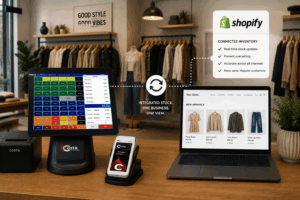
When your EPOS and Shopify store are integrated, sales and stock information can move between the physical and online sides of the business rather than requiring both to be managed independently.
That creates a much clearer picture of how the entire business is performing.
A product might be slow-moving in-store but performing strongly online.
Another could be selling quickly across both channels and approaching a stock shortage.
Without connected systems, those patterns can be much harder to see.
Promotions Need to Be Measured Too
Discounting can increase sales quickly.
But increased sales don’t automatically mean a successful promotion.
If you reduce a product from €100 to €80 and sell more units, the sales volume might look impressive.
The real question is whether the additional sales justified the reduction in margin.
The same applies to seasonal sales, loyalty promotions and discount codes.
Retailers should be able to compare performance and understand whether a promotion genuinely increased profitable sales rather than simply giving existing customers a cheaper price.
Better Decisions Start With Better Information
The latest retail figures highlight something every retailer should keep in mind:
Revenue and growth aren’t always the same thing.
In June, Irish retail sales value was 2.8% higher than a year earlier, while sales volume increased by only 0.6%.
At the same time, consumers are dealing with higher prices, with overall Irish consumer prices increasing 3.4% year-on-year in July and clothing and footwear among the categories experiencing particularly strong price increases.
For retailers, understanding what’s happening behind the sales figure has become increasingly important.
The right EPOS system shouldn’t just process transactions.
It should help you understand them.
See More Than Your Sales Total
At Costa Systems, we provide retail EPOS solutions designed to give businesses greater visibility over sales, stock and performance.
From detailed reporting and stock management to ecommerce integration, our systems help retailers understand what’s actually happening across their business — not just what’s going through the till.
Because knowing that sales are up is useful.
Knowing why they’re up is what helps you make the next decision.
Want to see what your retail system could be telling you? Contact Costa Systems to discuss your current setup and see how we can help.
Related posts


